

During his participation in the preparatory meetings for the Arms Trade Treaty
Okeil calls for strengthening the universality of the Arms Trade Treaty in the Arab region
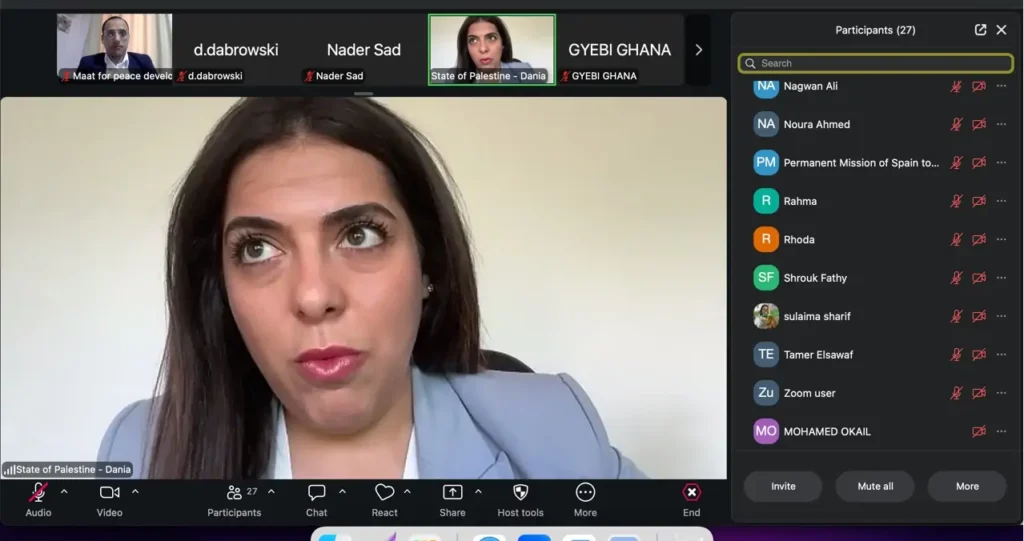
Ayman Okeil, President of Maat for Peace, Development and Human Rights, and Vice President of the African Union ECOSOCC, participated in a panel discussion on the role of regional actors in promoting the universality of the Arms Trade Treaty in the Arab region. This took place during the preparatory meeting of the working groups for the Twelfth Conference of States Parties to the Treaty, within the framework of the meeting of the Working Group on the Universality of the Treaty.
In his statement, Okeil addressed the importance of strengthening the universality of the Treaty in the Arab region, especially in light of the escalating armed conflicts and civil wars it is experiencing. He emphasized that the illicit proliferation of weapons and their continuous flow to armed and terrorist groups has exacerbated conflicts and led to catastrophic humanitarian crises, resulting in the deaths of thousands and the displacement of millions in areas that often remain largely overlooked.
Okeil noted that the League of Arab States plays a limited role in preventing weapons from reaching terrorist groups and armed factions. He pointed out that the League's Department of Arms Control and Disarmament has not made any tangible efforts to promote the universality of the Treaty since 2014. He affirmed that Maat is currently seeking to establish communication channels with the League to organize activities aimed at clarifying the Treaty's objectives and importance.
Okeil also noted the lack of direct interest from the Arab Parliament in the issues raised by the Treaty, as it has not issued any resolution or official document prioritizing it in legislation. He explained that the Parliament focuses more on other issues, such as making the Middle East a zone free of weapons of mass destruction and countering the threat of artificial intelligence.
In closing, Okeil outlined the challenges hindering Arab states' accession to the treaty, most notably political concerns related to national security, legislative and technical obstacles and financial obligations, the prevailing perception that the treaty focuses on exporting countries and neglects the needs of importing countries, and the limited number of civil society organizations specializing in conventional arms issues in the region.
He also revealed Maat's upcoming steps to curb the proliferation of conventional weapons and promote the universality of the Treaty in the Arab region. These steps rely on a "participatory national consultation methodology" across three levels. The first level focuses on initiating dialogue with representatives of national parliaments to assess existing laws and propose amendments to legislation that aligns with the Treaty's standards, while also supporting parliamentary capacity building.
The second level involves leading a national dialogue with representatives of executive authorities in Arab states.
The third level consists of organizing consultative workshops aimed at unifying advocacy efforts and fostering an informed Arab public opinion regarding the provisions of international agreements. This includes engaging youth and women, who are disproportionately affected by armed conflicts, with the goal of formulating a comprehensive Arab societal vision for achieving a secure Arab region.
shortlink: https://safearabregion.org/en/?p=45990


 English
  العربية