

Maat: Taking remedial steps for human rights in the Arab region is a sign of strength, not weakness
Okeil: The cost of addressing the challenges facing human rights in Arab countries is far less than the cost of ignoring them, no matter how long it may take
Aly Mohammed: Civil society in the Arab region is called upon to work to achieve the greatest possible good for the largest number of people
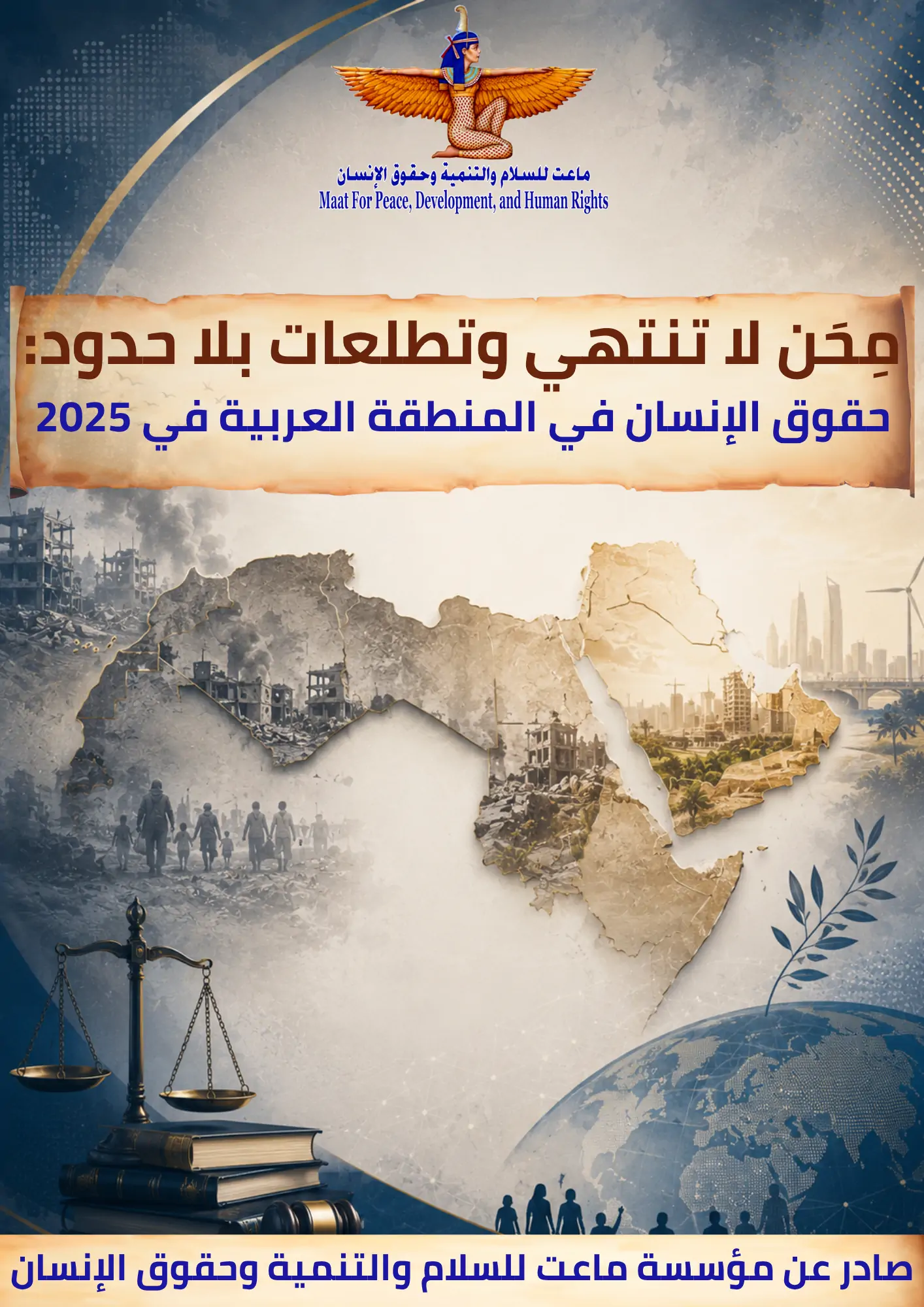
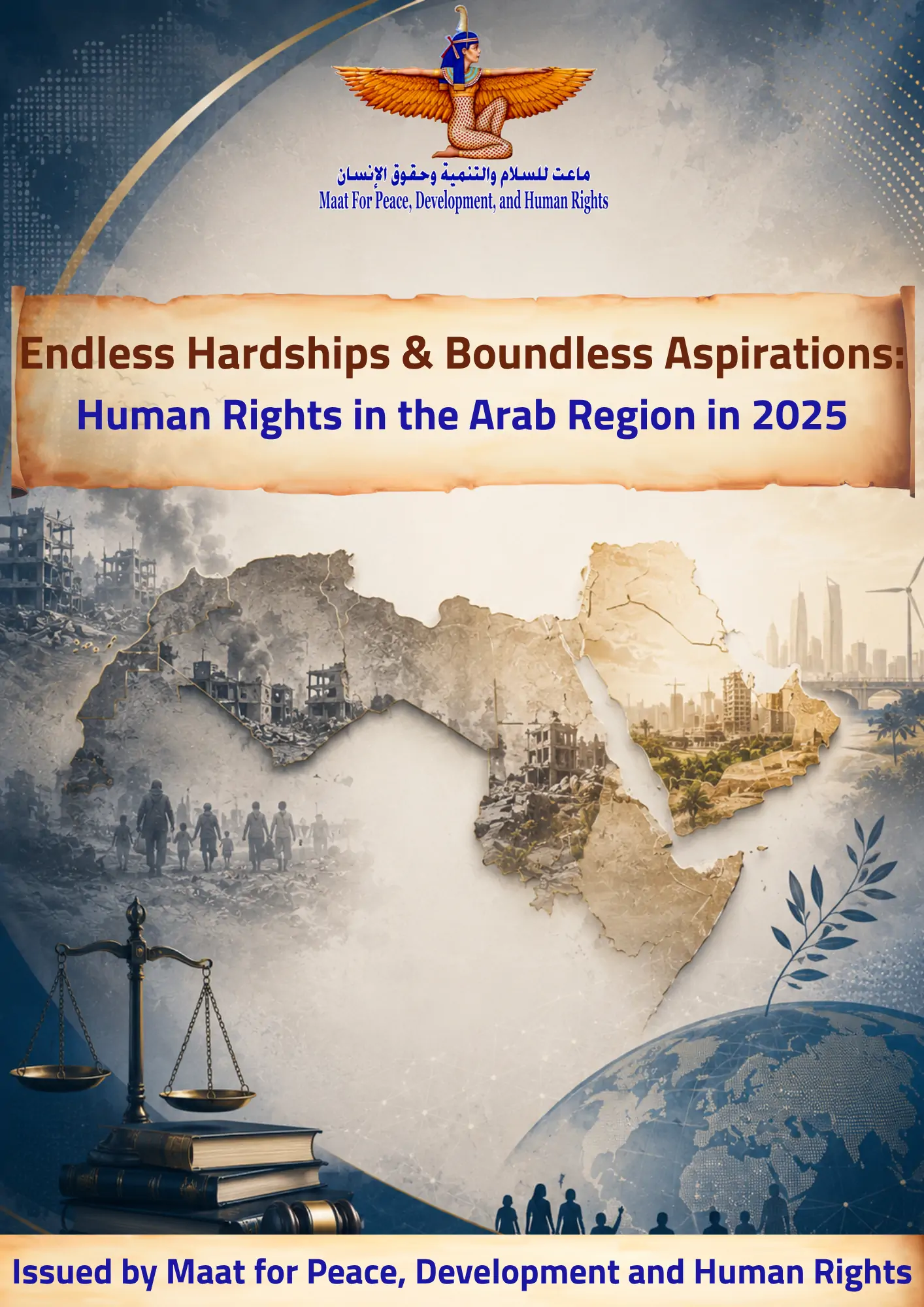
Maat for Peace, Development and Human Rights has issued today its ninth annual report on the status of human rights in the Arab region, titled “Endless Hardships & Boundless Aspirations: Human Rights in the Arab Region in 2025.” The report documents and analyzes developments and incidents regarding the human rights situation in the Arab region during 2025, along with the implications of these developments at present. The report, an extension of Maat’s previous annual reports on human rights in the Arab region, consists of four sections. The first section, introduced in the report’s ninth edition, focuses on human rights in the era of militias. The second section examines human rights trends in the Arab region through 22 country reports on Arab states. The third section addresses the stance of Arab states toward international human rights mechanisms. The final section focuses on the stance of Arab states toward the Sustainable Development Goals. The report reviews, based on evidence grounded in factual documentation of human rights practices, the situation in 22 Arab states. It also highlights the challenges that hinder progress in human rights and the achievement of the Sustainable Development Goals. The researchers contributing to the report sought to reflect the situation objectively and scientifically across the Arab region in 2025, in terms of both the data and information available.
The report considered that 2025, despite the gloom that prevailed, was marked by the spread of armed conflicts in Arab countries; by the crimes committed by the Israeli occupation authorities in Palestine, Lebanon, and Syria; by the illicit transfer of weapons to rebellious militias in some Arab countries such as Sudan, Yemen, and Somalia; and by diplomatic recognition of unlawful entities in the Arab region. Nevertheless, it also carried signs of promising developments that emerged in certain positive areas, including the release of a number of detainees held for cases related to freedom of opinion; the opening of broader civil space in some Arab countries; the expansion of political participation in some Arab states; directives to develop national human rights strategies and action plans; and the ratification and signing of a number of international and regional human rights treaties and agreements.
Arab states also witnessed legislative developments related to rights and freedoms, criminal justice, and ensuring freedom of the media. The report expressed the view that the application of these laws in actual practice remains the deciding factor in determining the effectiveness of such laws. It further explained that Arab governments have launched initiatives to strengthen economic and social rights and to support the most vulnerable groups. However, the report clarified that challenges were sometimes greater than the capacity of these states to respond to all requirements, particularly in areas experiencing armed conflict and violent tensions, where the spread of armed militias and terrorist groups, as well as the illicit flow of weapons from third parties, further fuels these challenges.
The report reveals that the status of women and women’s rights are among the central issues addressed in the country reports. It shows that positive developments benefiting women exist in many Arab countries. For example, Morocco extended the implementation of its National Action Plan on Women, Peace and Security until December 2026. In Egypt, the issuance of Presidential Decision No. 447 of 2025, by which women judges were appointed to the State Council, had a positive impact on women’s rights and their empowerment to hold leadership positions. In Saudi Arabia, the proportions of women in mid-level and senior administrative roles increased. Some restrictions on women, particularly regarding driving in Riyadh, were lifted. At the same time, the report noted that, despite some positive initiatives, thousands of women across the Arab region continue to face high levels of domestic and societal violence and limited opportunities for advancement into leadership positions. In areas affected by armed conflicts, the effects were compounded for women: they lacked access to reproductive health services, and political participation remained weak. In Gulf states, despite positive initiatives achieved for women, nationality laws prevented equality between women and men, as these laws barred women from granting nationality to their children when the father (the husband) is a foreign national. In its recommendations to a number of states, the report called for the study of reviewing and developing national legislation on women’s rights in a way that considers the human rights dimension.
The report also shows, with evidence, that armed conflicts and violent tensions in the Arab region, along with the armed attacks resulting from them, have had civilian casualties who were harmed more than others. The list of victims included people with no connection to any party to the conflict, including women, children, and older persons. This has led to the loss of civilian lives in Palestine, Sudan, Yemen, and Somalia; the dead were falling by the hundreds each month in indiscriminate attacks that are classified as war crimes. In the section newly introduced this year on human rights in the era of militias, the report concludes that the practices of the separatist movement in southern Yemen and the Houthis in northern Yemen, as well as the Rapid Support militias in Sudan, the Polisario Front, and the separatist government in “Somaliland,” have had serious consequences for civilians in the areas under their control, and have caused significant losses to their national economies. As a result, armed militias and non-state actors, moved by third parties, have become the arbiters of the fate of some peoples. They justify this by invoking the illicit flow of arms and ammunition, spreading hate speech and misinformation, and recruiting hundreds of people out of need and want.
Ayman Okeil, an Expert in the Field of Human Rights, Chairman of Maat, and a member of the National Council for Human Rights, stated that 2025, and the major events that followed, require addressing the challenges facing the advancement of human rights in the Arab region. He revealed that the Israeli occupation authorities continue to seek to annex more territory in Syria, Palestine, and Lebanon. He also considered that terrorism, organized crime, and rising poverty levels constitute genuine threats facing the Arab region, and that they require collective responses from Arab states and the Arab League under its new leadership.
Okeil also drew attention to the fact that the war initiated by the Rapid Support militias in Sudan still harms civilians the most. He explained that this war is a bad omen for Sudan and its people, and called for the need to pursue the leaders of Rapid Support who are implicated in crimes against civilians. He further stated that the Somaliland government is trying to spark tensions in the Red Sea and in the Horn of Africa by calling up a purported, yet spurious and unlawful, diplomatic recognition by the Israeli occupation authorities.
He praised the commitment of some Arab states to engage with international and regional human-rights mechanisms, as demonstrated by Oman’s accession to the International Covenant on Civil and Political Rights and Lebanon’s signing of the Convention on the Rights of Persons with Disabilities. He also cited Somalia’s ratification of the African Charter on the Rights and Welfare of the Child, and Djibouti’s signing of the African Union Convention on Ending Violence Against Women and Girls.
In contrast, Okeil commended the policies and legislation adopted by Arab states to implement the Sustainable Development Goals, but he called for accelerating the pace of work and doubling efforts to implement these goals, as 2030 approaches, the deadline for completing the timeline of the 2030 Agenda. He concluded his remarks in Maat’s annual report by stating that the cost of addressing the challenges facing human rights in Arab countries in the long term is far less than the cost of ignoring them, no matter how great that cost may become.
For his part, Aly Mohammed al-Jamal, Deputy Director of Maat for Research, said that Arab states are at a decisive moment: either they cooperate to overcome moments burdened with challenges, work to prevent disputes by cutting off their sources, and counter attempts to undermine stability while preserving sovereignty; or they choose the darker option, weakness, fragmentation, and division based on disputes supported by third parties.
He added that civil society in Arab countries must follow the logic of achieving the greatest possible good and gains for the largest number of people, and must not surrender to the logic of the collapse of international law. In the end, Maat encouraged Arab states to take reform steps to strengthen human rights, and considered that these steps will reflect a logic of strength and confidence in institutions and other stakeholders, such as civil society and national human rights institutions. Maat also considered that any objective assessment of reform steps in the field of human rights cannot, in any way, be explained on the basis of weakness or a response to external pressure.

 |
 |
shortlink: https://safearabregion.org/en/?p=46680



 English
  العربية